Step Away from the Canvas: The Agonising Art of Knowing When to Stop
Hey everyone, welcome back to the studio!
In our last couple of chats, we’ve looked at the physical mess of a fluid art studio and the steep learning curve of practicing different pouring techniques. But today, I want to talk about a hidden part of the process that doesn't involve mixing recipes or blowing air bubbles. It is purely a mental game, and honestly, it might just be the hardest skill in all of abstract art: knowing when a piece is officially done.
When you are working with traditional landscape or portrait painting, you have a relatively clear finish line. Once the tree looks like a tree, or the eyes match the reference photo, you are nearing the end.
But with fluid art? There is no map. There is no reference photo. You are working with a moving, living medium that is shifting right in front of your eyes. Because of that, the line between a masterpiece and a muddy mess is razor-thin—and crossing it usually happens in a split second.
The Agonising Internal Monologue
Picture this: I’ve just poured a fresh canvas. The colors are separating beautifully, the cells are crisp, and there’s a stunning, dramatic sweep of paint cutting right across the center. It looks incredible.
But then, that dangerous little voice in the back of my mind whispers: “You know what would make this perfect? Just one more tiny tilt to stretch that corner.” Or, “What if we blast this one little spot with the torch just to see if we can coax out one more cell?”
This is the exact moment where the real battle begins. It is the agonizing internal monologue of an artist standing over a wet canvas, tool in hand, actively trying to fight their own instincts.
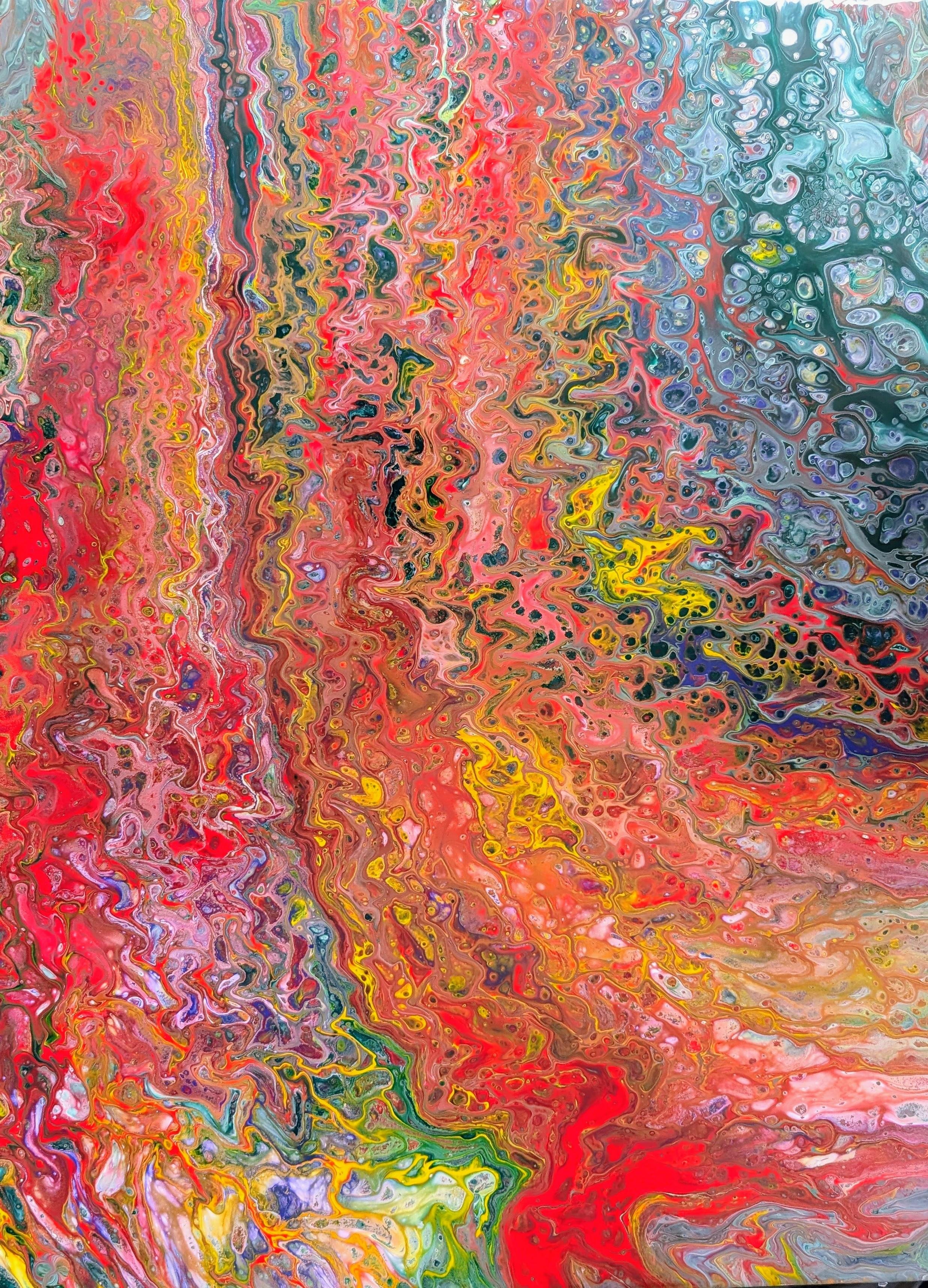
Copper Veins
One of my earliest paintings. Don’t get me wrong, I still love it, but to my more experienced mind it is very busy. Nowadays I would stop much earlier and not tilt so much, but that is my preference.
It just proves that beauty is very much in the eye of the beholder, different people see different things and are drawn to different styles.
There is no right or wrong with this. It is deeply personal.
Fluid art requires you to act fast, but it also requires you to know when to completely freeze. One extra tilt of the canvas can over-stretch a beautiful pattern until it distorts and loses all its energy. One too many blasts with a hairdryer can force the colors to blend too much, muddying up those crisp lines you worked so hard to create.
The temptation to overwork a piece is massive because, as creators, we always want to refine, perfect, and tweak. But with a fluid medium, perfection is found in the spontaneity. The moment you try to over-intellectualize it or force it to do one more thing, the magic completely vanishes.
The Drying Shift
To make matters even more complicated, fluid art has a sneaky habit of changing after you walk away. When the paint is wet on the canvas, it’s still moving, ever so slowly, responding to gravity and the leveling of the surface.
I’ve had moments where I looked at a wet canvas and thought, “I’m not entirely sure about this section,” but I forced myself to put my hands in my pockets and step away. Then, twelve hours later, after the paint settled and dried, that exact section turned out to be the most intriguing, beautiful part of the entire painting.
Learning to stop means trusting that the paint knows what it’s doing, even when it doesn't look exactly how you imagined it in your head. It’s about respecting the canvas enough to let it have the final word.
Hands in Pockets
Over time, I’ve had to develop a very strict studio rule for myself: When in doubt, step away.
If I find myself hovering over a painting for more than two minutes trying to decide if it needs "one little tweak," the answer is always a resounding no. I physically put my mixing sticks down, turn off the torch, step out of the room, and go make a cuppa. Ninety-nine percent of the time, when I walk back in with a fresh pair of eyes, I am so incredibly grateful that I didn't touch it.
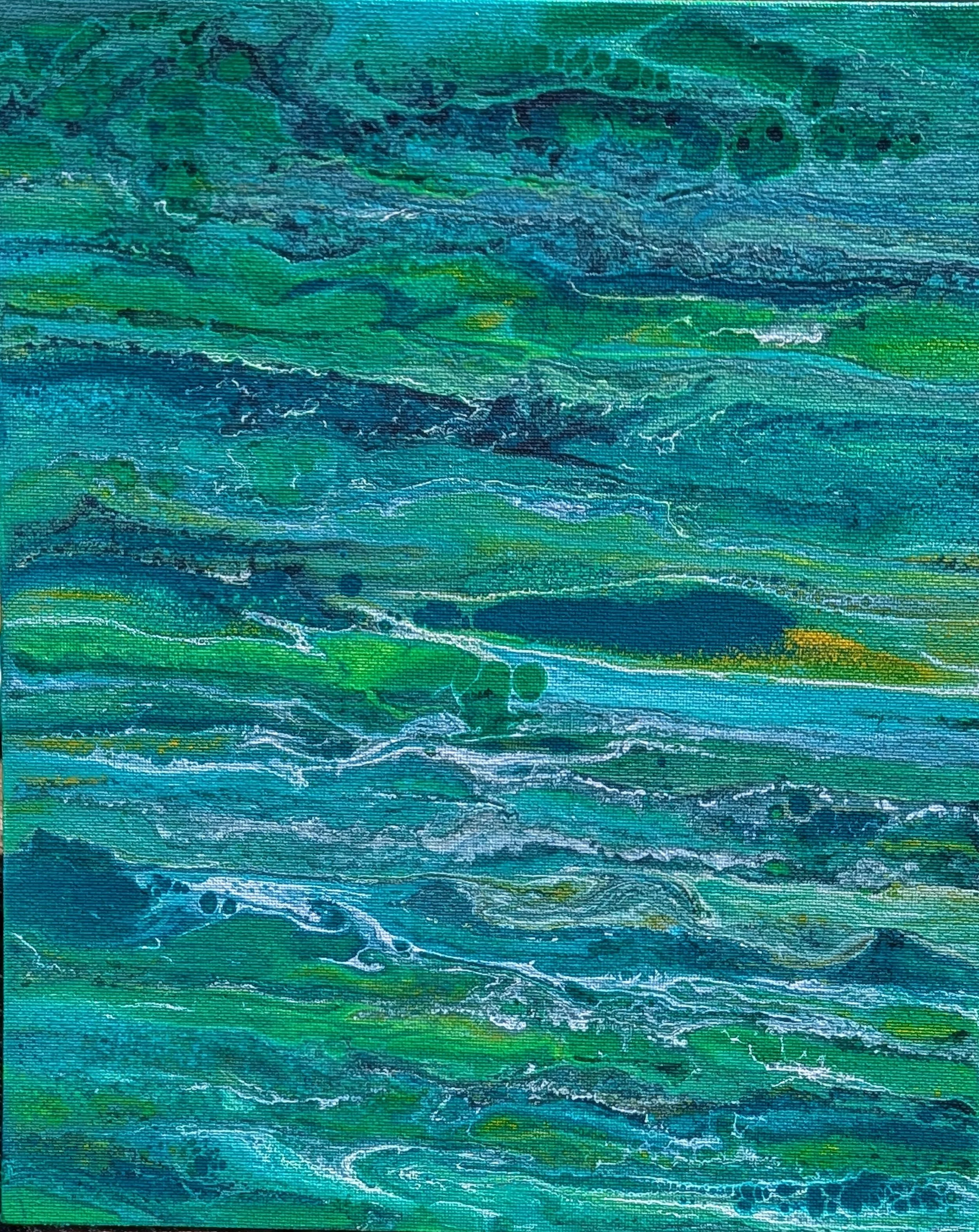
Inlets
A simple swipe. I love this one.
Although there is a lot going on in this painting it was created in just a few swipes with damp kitchen roll.
Then I walked away. Less is more.
Abstract art isn't just about the physical paint you put down; it’s about the restraint you show by leaving the composition alone. Knowing when to stop is a practice in humility. It's the moment you stop fighting the canvas and say, "You're beautiful just as you are."
To my fellow artists and creators—whether you paint, bake, write, or garden—how do you know when a project is officially finished? Do you struggle with the urge to overwork things as much as I do? Let’s swap overthinking stories in the comments!
Until next time, put your hands in your pockets and……
Enjoy the flow!
Bex Haigh
