Chasing the Perfect Pour: The Myth of the "Right" Method in Fluid Art (Copy)
Hey everyone, welcome back to the studio!
Now that we’ve talked about the absolute chaos of a working fluid art space, I want to pull back the curtain on something that every single beginner—and honestly, every seasoned artist—wrestles with at some point: the process.
When you first discover fluid art, it’s incredibly exciting. You see a video online of someone effortlessly swiping a palette knife across a canvas, creating an instant explosion of perfect, lace-like cells. You think, “Brilliant, I can do that!”
But then you open up Google or YouTube to figure out how to actually mix the paint, and you are immediately hit with a wall of technical jargon. You hear about Dutch pours, ring pours, straight pours, open cups, tree rings, and the famous "bloom" technique. Then come the recipes: mix with water, mix with professional pouring mediums, use glue, use Australian Floetrol, use silicone oil, use hair serum.
Suddenly, your fun new hobby feels like a high-level university chemistry exam. It’s easy to get completely paralyzed trying to find the single, perfect, infallible answer to making fluid art work.
But I'm going to let you in on a little secret: there isn't one.
The Myth of the Perfect Recipe
In fluid art, there is absolutely no such thing as a one-size-fits-all, foolproof method. Every single technique you see online has its own quirks, its own flaws, and its own massive learning curve.
Take the classic "bloom" technique, for instance. When it works, it’s spectacular—it gives you those mesmerising, floating cells that look like living organisms. But if your paint density is off by even a fraction of a gram, or if your hairdryer is on the wrong speed, the whole thing completely collapses into a muddy puddle. On the flip side, something like a straight pour or a ring pour might feel a bit more predictable, but manipulating those rings to stretch across a canvas without distorting the pattern takes a ton of physical practice.
The truth is, what works beautifully in a sunny studio in Florida might completely fail in a drafty workspace in Suffolk because of humidity and temperature changes. A recipe that works perfectly with one brand of acrylic paint will turn into a clumpy mess with another.
Every method has its vulnerabilities. None of them are perfect.

Stormy Coast
Wooden Panel 35cm x 28cm
An abstract take on a seascape, combining deep blues and bright teals with a textured, metallic grey horizon.
The sea was created with a swipe method, and it was one of the first times that I had tried this.
Finding Your Flow
Because there is no holy grail recipe, the real secret to fluid art isn't about memorising someone else's exact measurements. It comes down to three things: trying different methods, finding what actually makes sense to you, and then practise, practise, practise.
When I was learning, (I still am) I tried techniques that other artists swore by, only to find they drove me absolutely crazy. And that is completely okay! You have to give yourself permission to play the mad scientist. Try a Dutch pour using a hairdryer. If you hate the noise and the flying paint, put the dryer away and try a flip cup instead. If you love the elegant, natural look of marble textures, spend your time figuring out how to layer whites and greys with metallic veins.
You have to find the method that matches your own rhythm and personality. Your intuition is a massive part of the recipe, and you can only build that intuition by making mistakes.
The Magic of Muscle Memory
There is simply no shortcut around the mileage of your hands on the canvas. You have to learn what the paint looks like when it’s at the right consistency—how it runs off the mixing stick, how it holds its shape for a split second before sinking back into the cup. You have to learn exactly how much to tilt the canvas to stretch a pattern without destroying it.
Every "failed" canvas is just data. It’s your brain and your hands figuring out the physics of the fluid.
So, if you’ve been wanting to try your hand at acrylic pouring but feel intimidated by all the different methods and complicated steps, my advice is simple: just grab a few cheap canvases, pick two or three colors you love, and start messing about. Don't worry about mastering the ultimate technique on day one. Just focus on seeing how the paint moves, accept that your first few tries might look like mud, and enjoy the process of figuring out what works for you. And remember, if you hate it you can always scrape the canvas and try again, so all is not lost
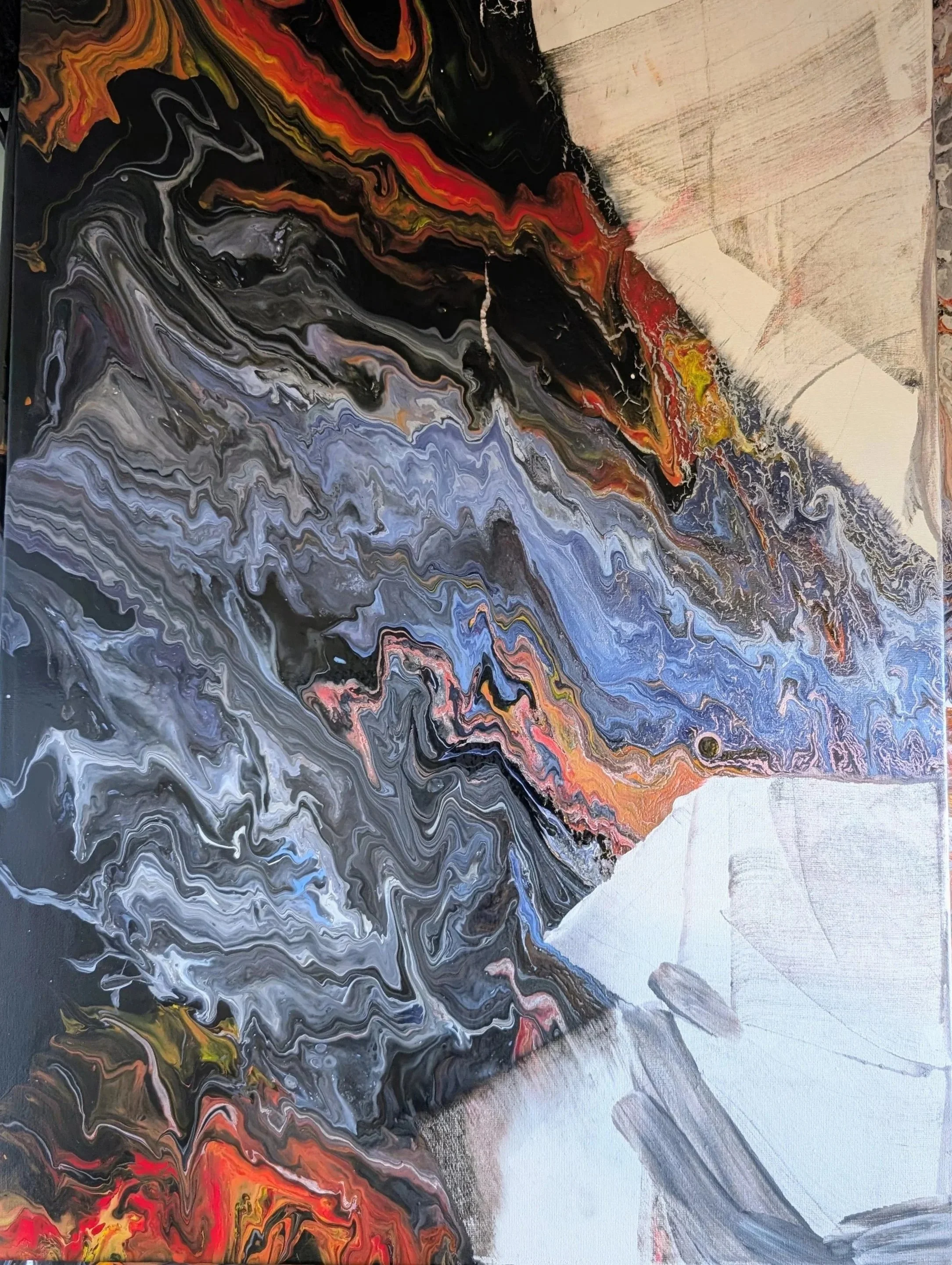
The first attempt
I hated this instantly. It just looked like a slurry mess to me. I’d made the fatal mistake of over tilting and ended up with everything far too busy. So, I scraped off the worst areas and poured again.

Final Painting
Fire and Ice - Canvas 60cm x 40cm
This is still not my favourite painting, but I am much happier with this attempt.
Sometimes less is more, and I needed to learn this and also learn when to give up and start again.
To the creators out there—which fluid art method gave you the biggest headache when you were starting out? And if you haven't tried it yet, which technique looks the most magical to you? Let me know in the comments!
Until next time, keep experimenting and ……..
Enjoy the flow!
Bex Haigh
